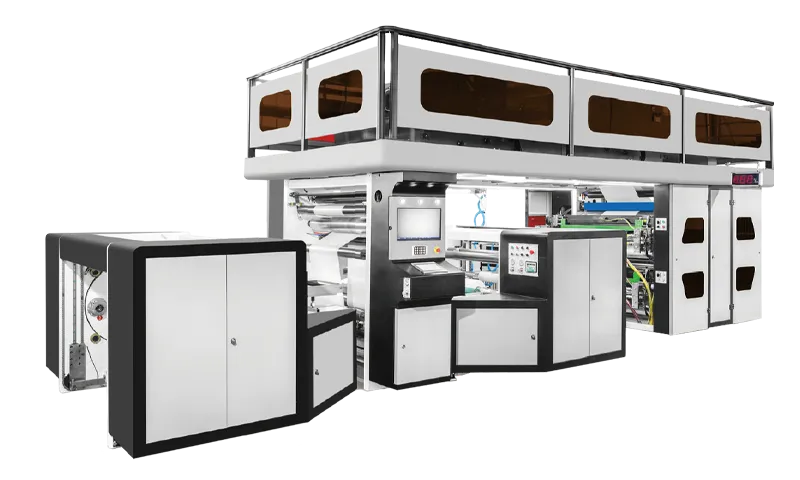
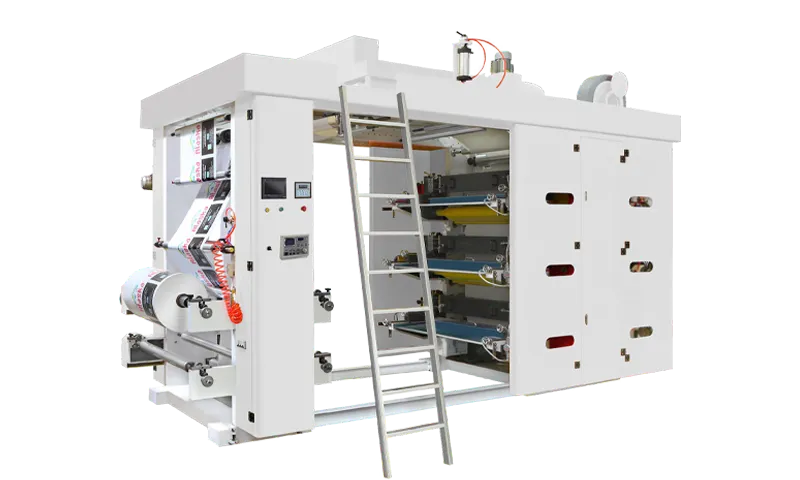
A paper cup converter in Southeast Asia kept rejecting rolls of pre‑printed cup sidewall stock. The three‑color logo shifted by as much as 0.5mm between the front and back of the roll, making the cup look second‑rate. Their old press couldn't hold registration through shifts when the paper tension varied. When the operator tightened the web after a roll change, the second color drifted; when the winder built up, the third color followed. The variance was the cost of doing business until they replaced the press.
What changed was not the paper. It was the way the stack-type flexo printing machines handled tension and registration. The 4‑color roll‑to‑roll stack press uses individual printing units stacked vertically, sharing a common web path. It prints paper cup and paper bowl blanks, BOPP films, and laminate stocks up to 1160mm wide at speeds of 250m/min. The core advance is split registration control: each color station has its own 360° motorized register adjustment, synchronized through a main PLC, so color‑to‑color drift is corrected without stopping the press.
A stack-type flexo printing machines system designed for cup and bowl packaging combines maximum print width on standard 1200mm material rolls, running paper weights from 120gsm to 400gsm at speeds that keep a downstream cup former fed. This article explains how the 360° motorized register system makes a full‑width color correction without screwing up an adjacent color, where the ±0.1mm registration spec lands on a 10,000‑meter printed film order, and why the modular drying layout lets you add an inter‑station UV dryer without rebuilding the press frame.
In a manually‑registered stack press, each color station has a handwheel that rotates the plate cylinder. The operator eyeballs the overlap between colors, turns the wheel, waits for the press to come up to speed, and checks again. For a 4‑color job, that sequence repeats four times. On a narrow‑web job, a skilled pressman might get it right in 20 minutes. On a 1000mm‑wide paper cup roll, the same adjustment takes twice as long because the web is heavier and the register marks are harder to see.
The 360° motorized synchronous wheel drive moves the plate cylinder in tiny increments controlled from the main touchscreen. The operator calls up the magenta station, types “+0.1mm”, and the servo motor rotates the cylinder precisely. The press does not stop. The change is applied on the fly, and the next impression shows the correction.
| Motorized Register Benefit | Why It Matters for Paper Cup Printing |
|---|---|
| On‑the‑fly correction | No stop‑and‑go waste during color setup |
| 0.01mm resolution | Fine enough to keep a brand logo centered on a tapered cup wall |
| All stations recallable | The next time the same cup job runs, the saved offsets reload in seconds |
For a converter who prints cup sidewall blanks for a chain of coffee shops, the difference between ±0.1mm registration and ±0.3mm registration is the difference between a pallet of saleable cups and a 20% scrap chargeback.
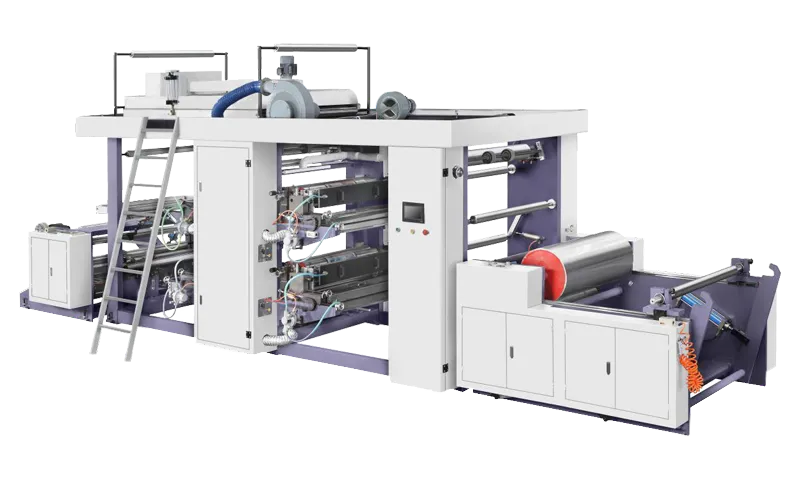
A stack-type flexo printing machines rated at 250m/min will hit that speed only if the substrate is uniform and the tension control holds. On a paper cup job, the web is not uniform. The high end of the roll sees tighter tension than the core end, and the paper expands microscopically when it picks up moisture from the water‑based ink. Those tiny changes add up to color shift unless the press compensates.
The registration accuracy of ±0.1mm means the brand logo on the cup appears in exactly the same position on the first cup of a roll and the last cup. For a folding carton or a coffee bag, a 0.1mm misalignment might pass unnoticed. On a tapered paper cup, a 0.1mm shift at the top of the print becomes a 0.3mm gap at the bottom of the cup wall. The customer sees the graphic miscentered when the cup is assembled.
The press achieves this through a servo‑driven tension control system that adjusts pull force in real time. A dancer roller with a load cell measures web tension every few inches of travel. When the tension changes, the infeed servo reduces or increases torque within cycles, not after the printed roll is finished. For a job that prints 10,000 meters of cup stock, the tension profile is stored in the PLC, so the same correction curve applies to the next order without recalibration.
Water‑based inks dry by evaporation. UV inks cure instantly under UV light. A stack-type flexo printing machines that will handle both on the same job run needs drying capacity between stations. The stack press’s vertical arrangement leaves room between the color units for hot air dryers or UV lamps. If you plan to print on BOPP film for clear cup sleeves, you will need UV curing. The modular design lets you specify inter‑station UV on the first three colors and hot air on the remaining stations.
For a converter printing cup sidewall blanks on PE‑coated board, water‑based ink is sufficient, and inter‑station hot air at 50‑60°C drives off the water without warping the paper. For the same converter printing shrink sleeves on PET film, the same press can be reconfigured with UV lamps between all four color stations, curing the ink before the next color is applied so there is no smearing or scuffing.
Each drying unit is independently controlled. The operator can turn off the dryer between color 2 and color 3 when printing a job with only three colors, saving energy and preventing overdrying of the substrate.
In-line finishing options and the path from printed roll to formed cup
A printed paper cup roll is not a finished cup. It must be die‑cut into cup sidewall blanks, then fed into a cup forming machine. The stack flexo press can be integrated with a slitter‑rewinder that trims the printed roll to the exact width of the cup former. The slitting station uses rotary knives that cut while the press is running at 250m/min, eliminating a second pass on a dedicated slitter.
The unwinder accommodates cores of 3 inches (76mm) and 6 inches (152mm). The rewinder is capable of building rolls up to 1000mm in diameter, enough to feed a high‑speed cup former for an entire shift without a roll change.
Xinxin (Zhejiang Xinxin Machinery Co., Ltd.) has manufactured flexographic printing equipment for over a decade. The ZYT4 high quality roll to roll 4 color flexo printing machine is part of their stack‑type portfolio, which includes configurations with 2, 4, 6, and 8 colors. The 4‑color unit is specified for paper cup and bowl converters who need full‑color process printing (CMYK) on cup sidewall blanks.
The machine is built with a maximum print width of 1160mm and accommodates material widths up to 1200mm. The 360° motorized synchronous wheel drive includes a touchscreen interface with recallable job storage. The unwinding and rewinding stations are shaftless, reducing roll change time. Drying is by hot air circulation, with UV inter‑station curing available as an option. The press can be supplied with an inline corona treater for film adhesion.
A stack-type flexo printing machines solution that holds ±0.1mm registration on coated cup stock at 250m/min, switches between water‑based and UV curing without rebuilding the press, and stores color offsets for repeat jobs reduces setup waste, eliminates misregister chargebacks, and keeps the cup former fed.
【Request a quote from Xinxin】
Send Xinxin your substrate type (paper, film, cup stock), maximum print width, and the number of process colors required to receive a ZYT4 stack flexo press configuration and a sample‑run report.

Fast response
Spare parts stock
Specialized commissioning and repairs/p>