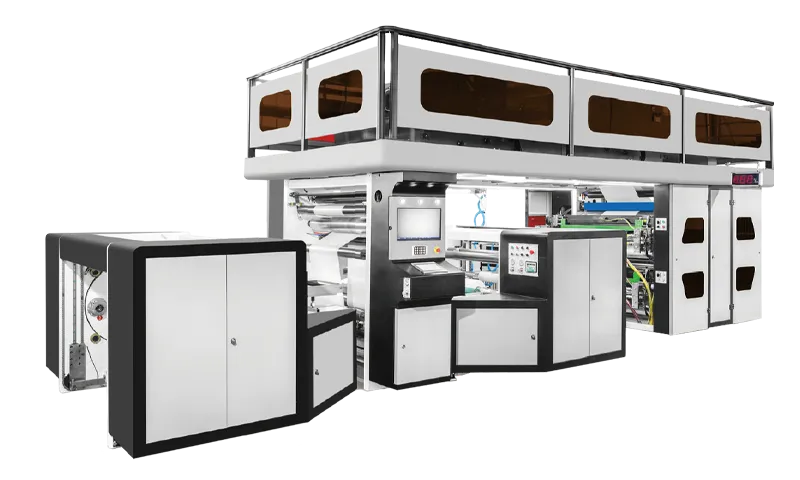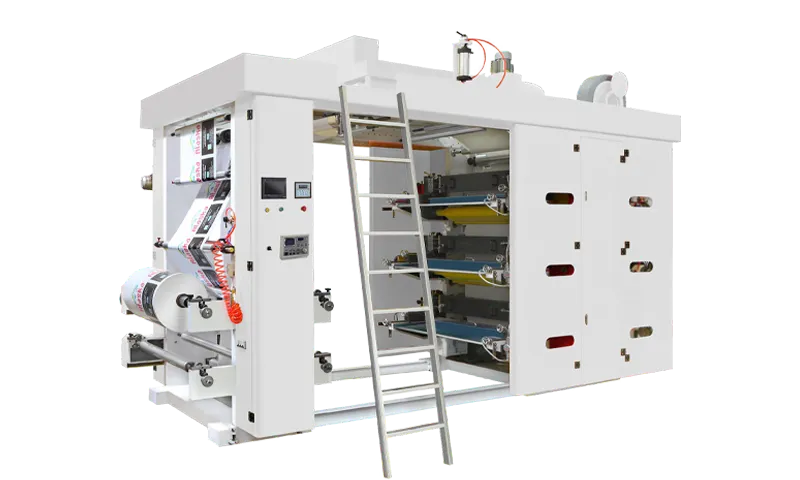
The main difference is the absence of a central drum. Each color deck operates independently, with its own plate cylinder, anilox roller, and impression cylinder. The web moves from bottom to top (or top to bottom) through each station, picking up one color at a time.
This layout brings several practical benefits:
Small footprint. A 6‑color stack press takes up roughly half the floor space of a CI press with the same color count. The footprint is determined mainly by web width, not by the number of colors.
Easy press access. Operators can reach every color deck from the front without climbing around a large drum. Plate changes and anilox cleaning are faster and less strenuous.
Double‑sided printing in one pass. By adding turning bars, the web can reverse direction and print the second side. CI presses cannot do this without a second pass.
Independent unit engagement. Need only four colors for a job? Simply disengage the other two decks. Each unit’s impression cylinder can be lifted off the web.
Xinxin’s stack presses are available with 2, 4, 6, or 8 color decks. The high‑speed 6‑color model is the most popular among paper bag printers.
Stack presses excel on materials that don’t stretch easily. They are widely used for:
Paper bags and paper cups
Corrugated board and cartons
Non‑woven shopping bags
Labels and tags
Plastic films that are relatively stiff (BOPP, OPP, PET)
Xinxin supplies 90% of paper bag machine supporting printers in China, and their stack presses are a key reason.
Where stack presses are less suitable: very thin, stretchy films like low‑density PE or cling film. CI presses maintain better tension control across all color stations because the web is held tightly against the central drum. For thin films, CI is still the better choice.
| Aspect | Stack‑Type Flexo | CI Flexo |
|---|---|---|
| Color unit layout | Vertical tower | Circular around drum |
| Floor space | Compact | Large |
| Double‑sided printing | Yes, with turning bars | No |
| Tension control on thin film | Moderate | Excellent |
| Changeover time | Shorter (independent decks) | Longer |
| Typical applications | Paper, board, non‑woven | Flexible film packaging |
The High Speed 6 Colors Flexo Printing Machine is one of Xinxin’s core stack‑type products. Its key specifications are:
Max speed: 250 meters per minute
Printing accuracy: ±0.1mm
Max material width: 1000mm (printing width 960mm)
Drive system: 360‑degree Motorized Point‑and‑Shoot Synchronous Wheel Drive
Registration adjustment: Electronic, from the control panel
This machine is designed for roll‑to‑roll, high‑speed production of paper bags, packaging boxes, and similar materials. The motorized synchronous wheel drive allows operators to register each color electronically, eliminating manual knob‑turning inside the press. Changeovers between jobs take minutes, not hours.
Xinxin‘s stack press lineup includes models for different needs:
GYT2 / ZYT2 — 2 colors, 1200mm width, for basic paper printing
GYT4 / ZYT4 — 4 colors, 1200mm width, with doctor blade or roll‑to‑roll options
GYT6 — 6 colors, 1000mm width, high speed (the model described above)
ZYT6 — 6 colors, 1200mm width, automatic stack type
GYT8 — 8 colors, 1200mm width, for BOPP/OPP/PET film
All models are built for continuous production with minimal operator intervention.
Consider a converter running a mix of paper bag jobs. Monday: 50,000 kraft bags with a simple two‑color logo. Tuesday: 30,000 white bags with a four‑color illustration. Wednesday: 20,000 brown bags with a one‑color stamp. A CI press would spend more time in changeover than in production. A stack press handles each job with recallable settings, independent deck engagement, and fast wash‑up.
Double‑sided printing is another real advantage. Many paper bags require printing on both sides. On a CI press, that means rewinding the roll and running it through a second pass — doubling labor and waste. With turning bars, a stack press prints both sides in one continuous run.
For converters serving e‑commerce, pharmaceutical, food pouch, personal care, and janitorial packaging markets, the ability to switch between paper, board, and film without major reconfiguration is a competitive edge.
Yes. By adding turning bars between color decks, the web can be flipped over and run back through additional stations. This is a standard configuration for many paper bag printers who need inside and outside printing.
It allows each color deck’s registration to be adjusted electronically from the control panel. The operator simply dials in the correction, and the drive motor rotates the plate cylinder to the exact position. No manual loosening of gears or guesswork.
With daily cleaning using non‑destructive methods (as recommended by Xinxin), anilox rollers can last several years. The key is avoiding abrasive cleaning tools that scratch the ceramic coating.
Adding color decks to an existing frame is not practical because the vertical height and drive system are fixed. Xinxin recommends ordering the number of colors you expect to need within the next three to five years.
Xinxin offers comprehensive after‑sales support: professional training, remote diagnosis, quick repair, fast response spare parts stock, and specialized commissioning. The company handles process materials including paper, cardboard, textiles, film, and metallic film. Packaging applications range from e‑commerce logistics and pharmaceutical labeling to food pouches, personal care, and janitorial packaging.
For a paper bag printer upgrading from a 2‑color to a 6‑color line, Xinxin’s team provides installation supervision, operator training, and ongoing technical support. Spare parts are stocked for fast delivery.
If your work is primarily paper, paperboard, or non‑woven materials — and you value quick changeovers, double‑sided printing, and a compact footprint — then a stack press is likely a better fit than CI. If you run thin stretch films daily, consider CI. Many converters keep both: a stack press for short‑run paper jobs and a CI press for long‑run film work.
【Request a quote from Xinxin for the High Speed 6 Colors Flexo Printing Machine】 — Share your typical substrates (paper, film, or board), average roll width, and monthly output. Their team will recommend the best stack configuration for your product mix.

Fast response
Spare parts stock
Specialized commissioning and repairs/p>