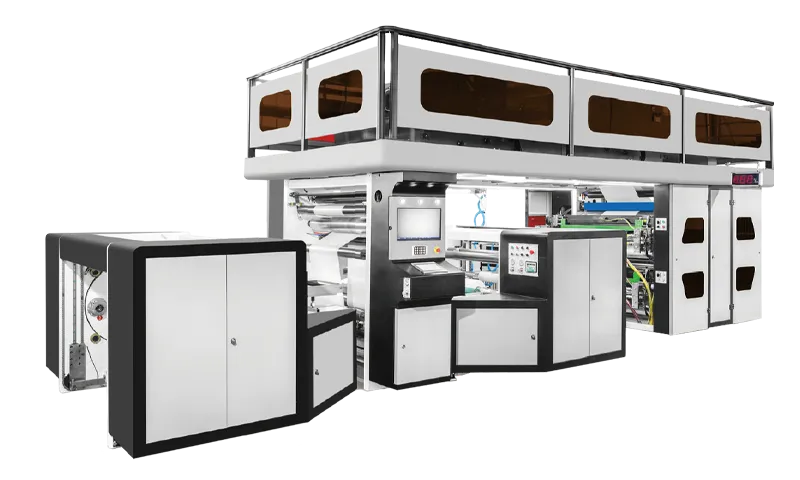
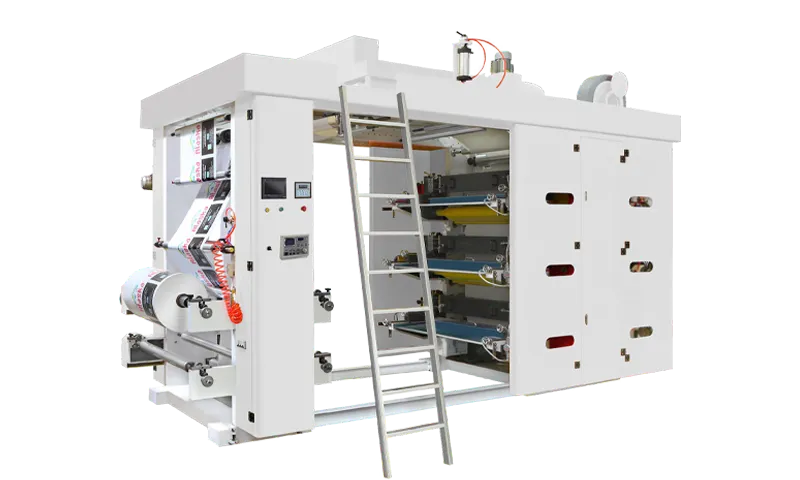
A roll of clear BOPP film feeds into the unwind station. It passes through a corona treater that raises the surface energy so ink will stick. Then it travels upward, past the first printing unit where a ceramic anilox roller transfers magenta ink to a printing plate, and the plate presses the image onto the film. The film continues to the second unit for the black ink. Between the units, hot air dryers evaporate the solvents, setting the ink before the next color is applied. At the delivery end, the printed film rewinds into a roll ready for slitting or bag making. Two colors. Done.
That is a stack-type flexo printing machines press dedicated to plastic film. The GYT2 model is a two‑color stack press that accepts web widths from 800mm to 1200mm, prints at speeds from 5 to 100 metres per minute, and holds registration within ±0.15mm. The vertical arrangement of the printing units keeps the web path short, which reduces the chance of film stretch and misregistration. This article explains how the doctor blade system meters ink evenly on non‑absorbent surfaces, why the corona treater is not optional for most plastic films, and where a 2‑color press fits in a flexible packaging line.
Plastic film stretches when pulled. A long web path with many turning rollers multiplies the tension variations, and the film length changes between colors, causing misregistration. A stack-type flexo printing machines press arranges the printing units one above the other. The web travels straight up, passing each unit in sequence. The distance between the first and second color is the height of one printing stack — typically 1‑2 metres, compared to 5‑10 metres on an inline press.
The short web path reduces the cumulative tension error. The GYT2’s printing units are vertically stacked, which minimizes the web path and reduces the chance of errors, enhancing overall productivity. The film sees fewer rollers, so it stretches less. For a thin 20‑micron BOPP film, the difference in registration drift between a short‑path stack press and a long‑path inline press can be 0.1‑0.2mm over a 5,000‑metre run — enough to make a two‑color logo appear blurred.
The compact arrangement also saves floor space. A 2‑color stack press occupies roughly the same footprint as a single‑unit machine. For a packaging converter adding a second press line, the stack press fits where an inline press would not.
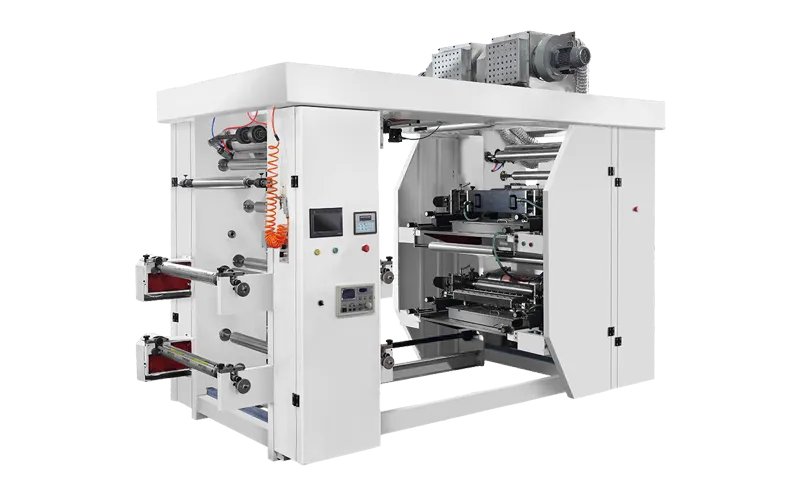
Plastic film does not absorb ink the way paper does. The ink sits on the surface. If too much ink is applied, it smears; if too little, the coverage is patchy. The doctor blade system controls the ink film thickness by scraping excess ink off the anilox roller before it transfers to the printing plate.
The doctor blade is a thin steel blade that presses against the ceramic anilox roller. The anilox roller has millions of tiny engraved cells that carry ink from the pan. As the roller rotates, the doctor blade wipes the surface clean, leaving ink only in the cells. The volume of ink transferred to the plate is determined by the cell depth and line count — a 200 LPI anilox with shallow cells lays down a thin ink film for fine text; a 120 LPI anilox with deep cells lays down a thick film for solid coverage. The GYT2 comes with a ceramic anilox roller and an enclosed doctor blade system that recirculates ink, reducing waste and keeping the viscosity consistent.
The doctor blade is consumable. A steel blade may last 20,000‑50,000 metres, depending on the ink abrasiveness. White ink, which contains titanium dioxide particles, wears blades faster than black ink. The operator checks the blade edge weekly; a worn blade will leave streaks in the print. The GYT2 is designed with easy access to the doctor blade for quick replacement. The enclosed doctor blade system also minimizes solvent evaporation, which is critical when using fast‑drying inks on high‑speed film runs.
The GYT2 is offered in three width configurations: 800mm, 1000mm, and 1200mm. The printing width is slightly less — 760mm, 960mm, and 1160mm respectively — to allow for edge trim. A 1200mm press can print 2‑across 550mm wide pouch film, or 3‑across 370mm wide label stock, or a single 1100mm wide shrink sleeve. The width range covers the majority of flexible packaging applications, from stand‑up pouches to flow‑wrap films.
For a converter who prints both narrow labels (300‑400mm) and wide pouch film (800‑1000mm) on the same press, the 1000mm model is the compromise. The extra width allows wider jobs, but the press still runs narrow stock efficiently because the web guide centers the film. The operator does not need to change guides when switching widths. The unwind and rewind stations accept rolls up to 600mm in diameter, enough for a 6,000‑metre roll of 30‑micron BOPP — about 1‑2 hours of running time at 100 m/min.
The press handles a wide range of materials, including paper, cardboard, textiles, film, metallic film, and a variety of packaging and labeling materials. It is particularly suitable for flexible packaging and pharmaceutical labeling.
| Parameter | GYT2‑800 | GYT2‑1000 | GYT2‑1200 |
|---|---|---|---|
| Colors | 2 | 2 | 2 |
| Max material width | 800mm | 1000mm | 1200mm |
| Max printing width | 760mm | 960mm | 1160mm |
| Unwind/rewind diameter | 600mm | 600mm | 600mm |
| Print length range | 230‑1000mm | 230‑1000mm | 230‑1000mm |
| Print speed | 5‑100 m/min | 5‑100 m/min | 5‑100 m/min |
| Register precision | ±0.15mm | ±0.15mm | ±0.15mm |
Data sourced from GYT2 product specifications.
On a white paper bag, a 0.2mm registration error between two colors may be visible but often acceptable. On a clear BOPP film used for a windowed pouch, any misregistration is immediately obvious because the viewer sees the back of the film through the front. A stack-type flexo printing machines (主词加粗第3次) press holds registration to ±0.15mm, which means a two‑color design printed on clear film will have overlapping images that align to within the thickness of a sheet of paper.
The press achieves this with a motorized 360° register adjustment for each printing unit. The operator adjusts the circumferential position of the plate cylinder while the press is running. A sensor reads the registration marks, and the servo repositions the cylinder. For a job that requires perfect alignment of a magenta background and a black outline, the motorized register eliminates the trial‑and‑error of loosening the plate cylinder clamp, rotating it by hand, and retightening.
The register precision also depends on consistent web tension. The GYT2 uses a magnetic powder brake on the unwind to maintain constant back tension, and a servo‑driven pull roll on the rewind to prevent the wound roll from pulling the web faster than the press is printing. The tension is set on the PLC touch screen; for thin films, the operator reduces the tension; for thick laminates, it is increased.
A 2‑color stack-type flexo printing machines press prints a single color in two shades, or two separate colors. The most common application is a base color plus a contrast color. For a coffee bag, the base is white for opacity, and the second color is brown for the brand text. For a shipping label, the base is white, and the second color is black for the barcode and address. For a frozen food pouch, the base is a solid color, and the second color is the product name.
A 2‑color press cannot print full‑color process (CMYK). That requires 4‑6 colors. But for the majority of flexible packaging — bread bags, produce pouches, plastic shopping bags, courier envelopes — two colors are enough. A 2‑color press costs significantly less than a 4‑color or 6‑color machine. For a small converter entering the flexible packaging market, the GYT2 provides a lower‑cost entry point without sacrificing the core capabilities needed for film printing: corona treatment, doctor blade metering, short web path, and ±0.15mm registration.
The GYT2 includes a corona treater as a standard feature. Plastic film has a surface energy of 30‑34 dynes/cm; water‑based inks require 38‑42 dynes/cm to wet out and adhere. The corona treater applies a high‑voltage discharge to the film surface, raising the surface energy. Without corona treatment, the ink will bead up and scratch off. The treater power is adjustable; for BOPP, a 2‑3 kW setting is typical; for PET, 3‑4 kW. The operator sets the power on the touch screen.
The GYT2 prints from 5 to 100 metres per minute. The low end of the range is for setup. The operator runs the press slowly to align the plates, adjust the registration, and check the first few metres of print. At 5 m/min, the operator has time to react before the web travels far. The high end of the range is for production. At 100 m/min, the press outputs 6,000 linear metres per hour — enough to print the daily requirement of a small‑ to medium‑sized bag plant.
Between the printing units, the press uses air drying systems with frequency‑controlled fans. The air flow is adjusted based on the ink type and speed. For water‑based inks at 100 m/min, the drying air is heated to 50‑70°C to evaporate the water before the film reaches the next color. For solvent‑based inks, the air is heated to 40‑60°C, and the press must be installed with exhaust ventilation to remove solvent vapours. The drying power is set on the PLC.
Xinxin Machinery has manufactured stack‑type flexo printing machines for paper bag and flexible packaging applications for over 25 years. The GYT2 model is a 2‑color stack press for plastic film printing. It includes a corona treater, doctor blade ink system, motorized 360° register adjustment, PLC touch screen with frequency control, air drying between units, 800‑1200mm web width, 5‑100 m/min printing speed, ±0.15mm register precision, and unwind/rewind diameter up to 600mm.
A stack-type flexo printing machines press that prints two colors on BOPP, PET, PE, and PVC films at 100 metres per minute, with registration accurate to ±0.15mm, keeps a flexible packaging line running without constant operator intervention. For a converter moving from paper to film, the GYT2’s corona treater, doctor blade metering, and short web path deliver the print quality that film requires.
【Request a quote from Xinxin Machinery】
Contact Xinxin with your film type (BOPP, PET, PE, PVC), web width (800‑1200mm), and target speed to receive a GYT2 configuration recommendation and a sample of printed film.

Fast response
Spare parts stock
Specialized commissioning and repairs/p>