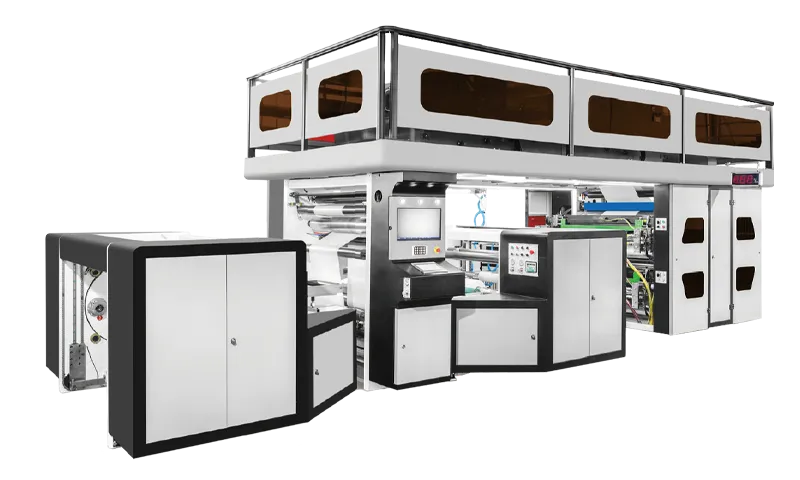
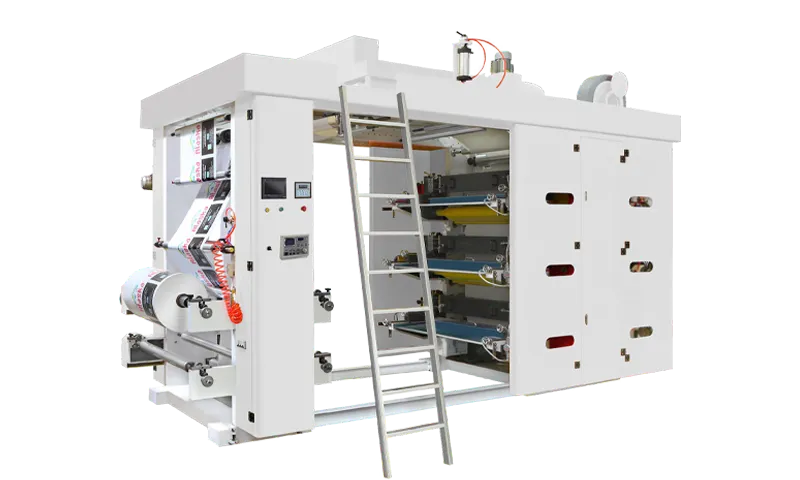
You need six colors, double‑sided printing, and a machine that doesn’t eat your shop floor. The ZYT6 stack‑type flexographic press puts six independent color decks in a vertical stack—not spread out like a train. You get multi‑color capacity in the space of a much smaller press.
A Stack‑Type Flexo Printing Machine works by moving the web upward (or downward) through each independent printing unit. Each station has its own plate cylinder, anilox roller, and impression cylinder. Drying sections between stations cure the ink before the next color hits.
The ZYT6 handles roll‑to‑roll materials: paper, film, non‑woven fabric, kraft, laminated paper, and plastic films (PE, PP, BOPP, PVC). It prints at 5‑100 m/min with register precision of ±0.15 mm. Maximum printing widths range from 760 mm to 1160 mm depending on the model.
Why stack? Unlike a CI press that wraps the web around a central drum, a stack press gives you independent access to each color deck. Change a plate or clean an anilox without crawling around a massive drum. The vertical design cuts floor space roughly in half compared to a CI press of the same color count.
The ZYT6 isn‘t just about fitting into small spaces. Its design cuts operational costs in three areas that matter to bottom lines.
Modular scalability. The stack design lets you start with fewer color decks and add more as your business grows. A 2‑color ZYT2 can be expanded to 4 or 6 colors without replacing the entire press—a feature CI presses cannot match.
Ink waste reduction. Mismatched anilox rollers and plates cause poor transfer rates—as low as 62 %, with 38 % of ink either accumulating on the anilox or spilling. Custom‑matched anilox mesh counts can boost transfer to 89 %, saving a single packaging factory 12,000 yuan per month in ink alone.
Lower energy consumption. LED UV curing—standard on Xinxin presses—cuts energy use by 60 % compared to mercury lamps. It eliminates VOC emissions and prints on heat‑sensitive recycled substrates that would warp under conventional dryers.
Unsegmented (single continuous paragraph, split into short sections)
The table shows the numbers. The story is what they mean on the floor.
| Model | Max Material Width | Max Printing Width | Colors | Speed | Register Precision |
|---|---|---|---|---|---|
| ZYT6‑800 | 800 mm | 760 mm | 6 | 5‑100 m/min | ±0.15 mm |
| ZYT6‑1000 | 1000 mm | 960 mm | 6 | 5‑100 m/min | ±0.15 mm |
| ZYT6‑1200 | 1200 mm | 1160 mm | 6 | 5‑100 m/min | ±0.15 mm |
Register precision of ±0.15 mm means your fine text won‘t turn into a fuzzy mess. For a 6‑color label, that‘s the difference between a product that looks premium and one that looks rejected.
Speed range of 5‑100 m/min covers both short, intricate jobs (slow) and long commodity runs (fast). You don‘t need a second press for small runs.
1300 mm unwind and rewind diameters mean longer runs between roll changes. Less downtime, less waste, fewer roll changes per shift.
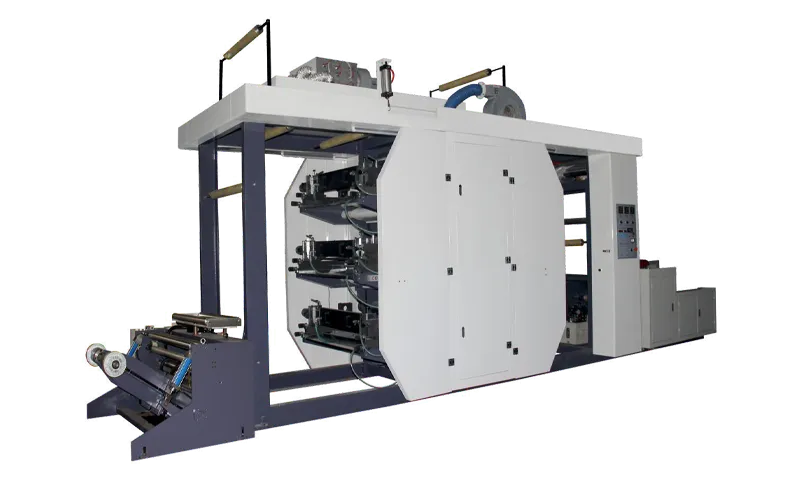
Even a well‑built stack‑type flexo machine has predictable failure points. Catch them early, and you avoid the 23 % waste rate that hits shops running random parameter settings.
Anilox/plate mismatch. When the anilox mesh count and plate depth are poorly matched, ink transfer drops to 62 %. The remaining ink either accumulates on the anilox or spills during printing. Fix: measure both and optimize with your material. Xinxin custom‑matching increased one factory‘s transfer rate to 89 %.
Over‑pressuring from chasing color. Operators often increase impression pressure when colors look weak. Wrong move. It forces ink into non‑printing areas, blurs edges, and wears plates faster. Fix: calibrate pressure once, then dial in color through ink formulation—not more force.
Ink formulation that doesn’t match the job. Using solvent‑based ink on porous paper? The ink penetrates too fast, operators keep adding more, and waste climbs. Using viscous ink on plastic? It won’t flow, causing buildup and clumping. Fix: match the ink chemistry to both the equipment and the substrate.
Paper bag printing demands consistent color, tight registration, and the ability to run both sides. Stack‑type flexo presses, with their independent decks and compact footprint, dominate this space.
Xinxin supplies the auxiliary equipment for 90 % of paper bag machine supporting printers in China. That‘s not a marketing claim—it‘s a number that reflects years of on‑site work. Xinxin’s team has conducted hundreds of on‑site debugging sessions, and their data shows that optimizing ink transfer, plate pressure, and cleaning systems reduces ink waste by an average of 35 %.
The ZYT6 series is used across e‑commerce packaging, pharmaceutical labeling, food pouches, personal care, and janitorial packaging. Process materials include paper, cardboard, textiles, film, and metallic film.
Clean the anilox roller at the end of every job. Use a soft cloth or air blower to remove dust, ink residue, and debris from the anilox, doctor blade, and impression cylinder.
Inspect the doctor blade regularly. A worn or damaged blade will not connect properly with the anilox roll, resulting in uneven ink metering. Replace the blade when you change the anilox roll or when the line screen changes by more than 100.
Check registration with a test print before full production. The ZYT6‘s ±0.15 mm precision holds across the speed range, but only if the web tension is stable and the plates are properly mounted.
Q: Can the ZYT6 print on both sides of the web?
A: Yes. Stack‑type presses support double‑sided printing through the addition of turning bars. The web can be reversed and fed back through additional decks, printing the second side in the same pass.
Q: What‘s the changeover time between jobs?
A: With motorized point‑and‑shoot synchronous wheel drive, operators can register each color electronically from the control panel. Semi‑automatic plate mounting cuts setup time in half. Typical changeover between similar substrates is 20‑30 minutes.
Q: How many colors can the ZYT6 actually run?
A: Six as standard, but the ZYT series ranges from 2 to 8 colors. The modular stack design allows for future expansion by adding more decks.
Q: What substrates cause the most problems?
A: Thin, stretchy films (under 20 µm) and uncoated kraft paper can flutter under high speed, causing registration drift. The ZYT6‘s servo tension control and web guiding system help, but for ultra‑thin films, a CI press may be a better fit.
Print buyers demand shorter runs, faster turnaround, and more customization. The old model—printing millions of copies—is giving way to printing thousands of copies. Stack‑type flexo presses thrive here because they change over quickly, handle diverse substrates, and run short runs profitably.
The ZYT6 is a stack‑type flexo printing machine that fits your shop floor, your substrate mix, and your growth plan. With 6‑color capacity, ±0.15 mm register, and speeds from 5‑100 m/min, it handles everything from paper bags to flexible films. The modular design lets you add color decks as you scale, and the auxiliary equipment ecosystem (servo tension control, automatic roll changing, high‑efficiency drying) keeps the line running.
Xinxin provides professional training, remote diagnosis, and fast spare parts delivery. Their technical team has helped hundreds of printers cut ink waste, improve registration, and scale production.
→ Request a quote from Xinxin for the ZYT6 stack‑type flexo printing machine — Share your typical substrates (paper, film, non‑woven), number of colors, and monthly production volume. Their engineers will recommend the right width, color configuration, and auxiliary modules for your line.

Fast response
Spare parts stock
Specialized commissioning and repairs/p>