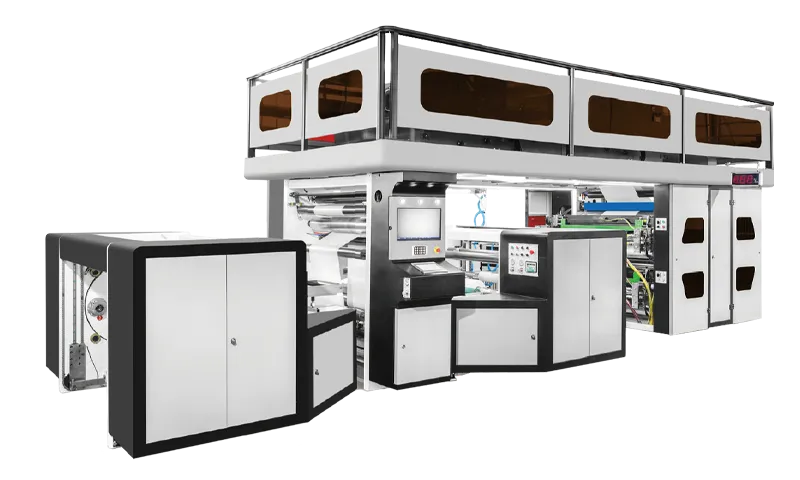
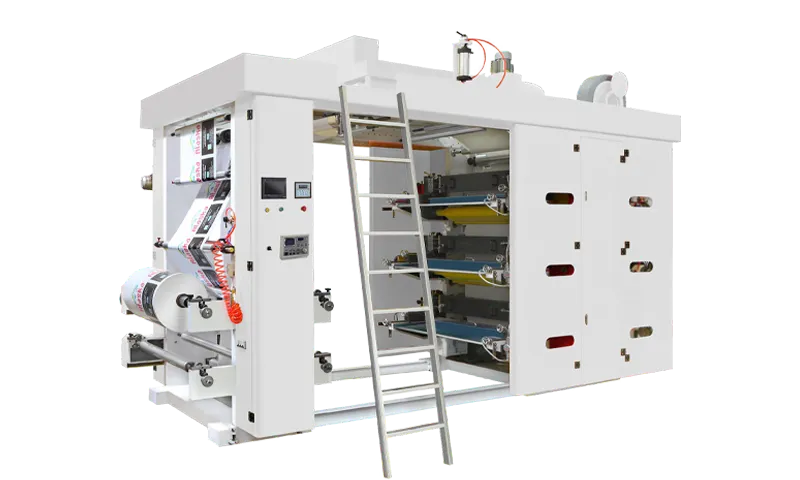
You're running a packaging line—producing food pouches, e-commerce mailers, pharmaceutical labels, or flexible films. The printing stage needs to be fast, accurate, and capable of handling multiple colors without constant adjustments. A stack-type flexo printing machine is built for this. It uses flexible printing plates and anilox rollers to transfer ink onto a wide range of substrates, with color stations stacked vertically to save floor space and simplify operation. This guide walks you through the key specifications, substrate versatility, control systems, and selection criteria—so you can choose the right press for your production environment.
A stack-type flexographic press operates on a roll-to-roll basis. The substrate—whether paper, film, cardboard, or metallic film—unwinds from a roll and travels vertically through each stacked color station. Each station applies a single color via a flexible printing plate, with precise registration between colors. The printed material then rewinds onto a take-up roll. This continuous process supports high-volume production runs with minimal manual intervention.
The defining feature of this press type is its vertical arrangement. Instead of spreading color units horizontally across a long production floor, the GYT6 series stacks them up. This compact footprint is especially valuable for print shops with limited square footage, allowing full multi-color capability without sacrificing valuable workspace.
The press runs continuously, taking material from an unwind stand and feeding it through all printing stations before rewinding. This eliminates the start-stop cycles of sheet-fed systems, significantly increasing throughput. With speeds up to 100 meters per minute, the machine handles both short-run custom jobs and long-run production with ease.
The GYT6 series comes in three width configurations: GYT6-600, GYT6-800, and GYT6-1000. The maximum printing material width ranges from 600mm to 1000mm, with actual printing widths of 560mm, 760mm, and 960mm respectively. The printing length range is 230-1000mm across all models, and each handles a maximum roller material diameter of 600mm. The press prints on paper, film, cardboard, metallic film, and textiles—making it a versatile workhorse for converters serving multiple market segments.
Choosing the right width is straightforward: match the machine's maximum material width to your widest roll stock. The GYT6-600 suits narrow-web applications, while the GYT6-1000 handles wide packaging and labeling jobs. The adjustable printing length range of 230-1000mm covers most repeat lengths used in flexible packaging.
From lightweight film to heavy cardboard, the press handles a diverse range of materials. This eliminates the need for multiple dedicated machines—one GYT6 press can switch between e-commerce mailers, food pouches, and pharmaceutical labels with appropriate plate and ink changes.
The GYT6 series uses a main motor frequency control system with PLC touch screen control for the entire machine. This interface allows operators to monitor and adjust printing parameters in real time, reducing setup time and minimizing waste during job changeovers. The 360-degree motorized synchronous drive system enables precise register adjustment across all color stations, ensuring every color aligns perfectly.
The 360-degree Motorized Point-and-Shoot Synchronous Wheel Drive system is a standout feature. It simplifies the registration process, allowing operators to adjust each color station independently while maintaining perfect synchronization. This reduces the skill level required for setup and speeds up changeovers between jobs.
Each color station has its own motor, providing independent speed and tension control. This is crucial when running substrates with different stretch characteristics—you can fine-tune each station to match the specific material, preventing misregistration and waste. The independent control also simplifies troubleshooting, as issues can be isolated to individual stations.
The GYT6 series delivers printing speeds from 5 to 100 meters per minute, adjustable to match job requirements. Register precision is held to ≤±0.15mm, ensuring color-to-color registration remains accurate even at higher speeds. The machine is designed to complete large printing volumes in shorter time frames, significantly improving production line output and overall competitiveness.
High speed doesn't mean compromised quality. The press maintains consistent ink transfer and registration accuracy across the entire speed range. This is achieved through robust construction, precise anilox roller control, and the synchronous drive system that keeps all color units in perfect coordination.
Core components like rollers are specially treated to resist wear, extending service life and reducing maintenance costs. This is critical for high-volume production environments where equipment uptime directly impacts profitability. The durable construction also maintains print quality over extended runs, reducing waste from gradual degradation.
Stack-type flexo presses are used across multiple packaging and labeling segments:
Food packaging: Pouch packaging, flexible films, food-grade paper, and confectionery wraps.
E-commerce and logistics: Shipping mailers, custom e-commerce packaging, and corrugated inserts.
Pharmaceutical: Labels, blister pack backing, and printed patient information leaflets.
Personal care: Shampoo sachets, cosmetic packaging, and hygiene product wraps.
Promotional materials: Branded packaging, display materials, and retail collaterals.
The ability to handle both paper and film substrates makes the press a valuable asset for converters who serve diverse market segments from a single production line.
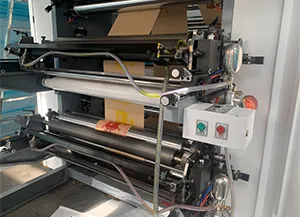
Beyond the base machine, several optional extras can streamline production and reduce external dependencies.
Using ultrasonic vibration, this accessory removes dried ink from the anilox roller surface. Regular cleaning maintains consistent ink transfer and extends anilox roller life, reducing the need for expensive replacements and ensuring print quality remains stable.
A flexo plate making machine enables in-house plate production, while a plate mounting machine ensures plates are positioned with exact precision. Having these capabilities in-house reduces reliance on external suppliers, accelerates job changeovers, and lowers overall production costs.
Xinxin provides comprehensive technical support, including professional training for operators, remote diagnosis for troubleshooting, and quick repair services. A responsive spare parts stock ensures minimal downtime, while specialized commissioning and repair services help maximize production efficiency.
| Specification | GYT6-600 | GYT6-800 | GYT6-1000 | Why It Matters |
|---|---|---|---|---|
| Max. material width | 600mm | 800mm | 1000mm | Determines maximum web size |
| Max. printing width | 560mm | 760mm | 960mm | Actual printable area |
| Printing length range | 230-1000mm | 230-1000mm | 230-1000mm | Repeat length flexibility |
| Max. roller diameter | 600mm | 600mm | 600mm | Roll size capacity |
| Printing speed | 5-100m/min | 5-100m/min | 5-100m/min | Production throughput |
| Register precision | ≤±0.15mm | ≤±0.15mm | ≤±0.15mm | Color-to-color accuracy |
| Control system | PLC touch screen | PLC touch screen | PLC touch screen | Ease of operation |
What substrates can this press handle?
The GYT6 series prints on paper, film, cardboard, metallic film, and textiles. This covers most packaging applications—from food pouches and pharmaceutical labels to e-commerce mailers and promotional materials.
What's the difference between stack-type and CI flexo presses?
Stack-type presses have each color station stacked vertically, saving floor space and allowing easier access for plate changes. CI presses use a single large central drum, which provides better print registration for stretchable films but requires more floor space and investment. Stack-type is often preferred for paper and cardboard, while CI is common for film.
How accurate is the color registration?
Register precision is held to ≤±0.15mm. With the 360-degree motorized synchronous drive system, registration can be adjusted precisely across all color stations, ensuring consistent quality even at high speeds.
What maintenance is required?
Routine maintenance includes cleaning anilox rollers, checking plate conditions, lubricating moving parts, and inspecting the tension control system. The wear-resistant treatment on core components extends service intervals, but regular inspection remains essential for consistent print quality.
Choosing a stack-type flexo press comes down to three decisions: width (match your substrate), colors (match your design complexity), and optional accessories (match your in-house capability needs). Request a quote or machine consultation → —Xinxin's team can help you select the right configuration for your specific production requirements.
This article was written with the assistance of AI to organise technical data from Xinxin's product documentation and industry standards.
Xinxin (Wenzhou Xinxin Printing Machinery Co., Ltd.) specializes in the development and manufacturing of flexographic printing equipment. The High Speed 6 Colors Flexo Printing Machine (GYT6 Series) is available in three width configurations—GYT6-600, GYT6-800, and GYT6-1000—with maximum printing widths of 560mm, 760mm, and 960mm respectively. The press features a PLC touch screen control system with main motor frequency control and separate motor control for each color station. Printing speed ranges from 5 to 100 meters per minute with register precision of ≤±0.15mm. The machine supports substrates including paper, film, cardboard, metallic film, and textiles. Optional accessories include an anilox roller cleaning machine, flexo plate making machine, and plate mounting machine. Xinxin provides comprehensive technical support, professional training, remote diagnosis, and quick repair services with responsive spare parts availability. Connect with Xinxin to discuss your substrate requirements, width specifications, and production volume needs.

Fast response
Spare parts stock
Specialized commissioning and repairs/p>